日本語 En français

Madagascar & Indian Ocean Islands

Tab 1

Overview
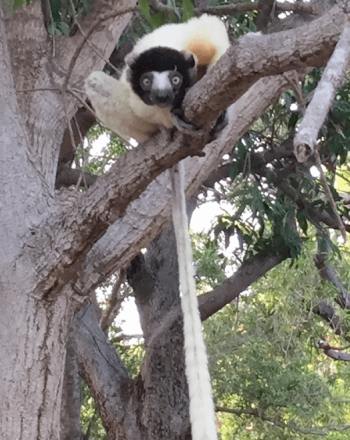
Black and white ruffed lemur, Madagascar

Located about 400 kilometers from the east coast of Africa, the island of Madagascar boasts plant and animal species that have evolved long in isolation from other land masses. In addition to Madagascar, the Madagascar and Indian Ocean Islands biodiversity hotspot includes the independent nations of Seychelles, the Comoros and Mauritius.

Our support focuses on maintaining the natural wealth of Madagascar, which includes tropical rain forest in the east, dry deciduous forests in the west and a unique spiny desert in the south. The island also hosts high mountain ecosystems characterized by forest with moss and lichens.

These critical ecosystems shelter at least 12,000 species of plants, 90 percent of which are found nowhere else. Often considered a mini-continent, Madagascar is famous for its diversity of chameleons and more than 50 different kinds of lemurs—unique primates found only here. New species are also being discovered at a rapid rate: 22 new mammal species and subspecies have been described in just the past 15 years.

While sheltering extraordinary concentrations of biological diversity, Madagascar has lost as much as 80 percent of its original forest cover. Slash-and-burn agriculture, mining and logging are among the main causes. Wetlands, including lakes, rivers and marshes, are also under threat from transformation to rice fields. 

Tab 2

Strategy
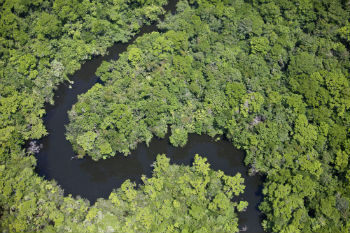
Forest in Mantadia National Park, Zahamena-Mantadia Corridor, Madagascar

Our investment in Madagascar began in January 2001 when key threats included agricultural expansion, uncontrolled livestock grazing; unsustainable charcoal production, mining, hunting and timber exploitation; and unregulated international trade in wildlife.

Compounding these threats was a civil society characterized by insufficient technical capacity and limited biodiversity information, alongside an inadequate government presence to manage and protect natural resources, and ambiguous policies. These factors presented a complex set of challenges.

Based on an ecosystem profile developed for Madagascar, CEPF sought to fill the gaps between existing efforts and investments, define mechanisms to ensure coordination among ongoing efforts and build the capacity of civil society to manage biodiversity conservation more effectively. Six strategic directions guided our approach:

  1. Integrating local groups and individuals into the management of protected areas and reserves.
  2. Private sector conservation initiatives.
  3. Biodiversity conservation and management training programs.
  4. Public awareness and advocacy.
  5. Small grants program (Biodiversity Action Fund).
  6. Creation of a participatory monitoring and coordination network.

Results from our five-year investment include the groundwork for a tripling of the nation’s protected area network. CEPF-supported projects yielded scientific data to justify the need for the increase and helped determine where these new areas should be located.

Our support also significantly increased the role of local nongovernmental and community groups in biodiversity conservation. CEPF supported local communities to manage and benefit from their natural resources, via community-based management contracts. Contracts between the communities and the government have, for example, been put into place in the Makira Conservation Area for 10 communities totaling 10,800 people for 38,000 hectares and in the Manambolomaty Lakes Complex for two “Associations” for management of freshwater resources.

In June 2009, we began implementing a seventh strategic direction to reinforce and sustain the gains made possible by our initial $4.25 million investment. This new strategic direction includes $1.4 million in targeted grants to selected organizations based on a consolidation plan drawing from the original ecosystem profile and an assessment of our previous investment.

Tab 3

Priorities

CEPF STRATEGIC DIRECTIONS CEPF INVESTMENT PRIORITIES

1.  Integrating local groups and individuals into the management of protected areas and reserves

1.1  Financial and technical support to existing parks and reserve management teams
1.2  Promotion of protected-area partnerships involving local and international NGO participation
1.3  Specific training programs for local groups
1.4  Participatory planning processes to develop corridor concept strategies (linking existing protected areas to form corridors)
1.5  Regional priority-setting and similar participatory processes
1.6  Basic biological inventories of existing and newly-protected areas, classified forests, and forest reserves
2.  Private sector conservation initiatives 2.1  Targeted initiatives such as:
- small-scale nature tourism projects linking benefits to communities
- plantation forestry models
- models of private sector engagement in biodiversity conservation
2.2  Research and development of appropriate carbon sequestration methods, such as:
- feasibility studies
- demonstration projects
3.  Biodiversity conservation and management training programs 3.1  Training programs such as:
- guide training
- training in species knowledge
- national university programs
- support for the collaborative creation of overseas training programs and scholarships
4.  Public awareness and advocacy 4.1  Awareness and information campaigns:
- promotions highlighting importance of biological diversity
- promoting biodiversity as a national asset
5.  Biodiversity Action Fund. Small grants not to exceed $10,000 5.1  Individual and start-up initiatives such as:
- small workshops
- critical travel needs
- field equipment and biodiversity publications
- individual and small scale grassroots conservation initiatives
6.  Creation of a participatory monitoring and coordination network 6.1  Creation and implementation of a coordination mechanism consisting of:
- a core alliance of organizations with significant technical capacity and strong program history in the region
- advisory panel to include a selection of top scientists
- participation in identification and review of potential CEPF projects
- an active role in monitoring CEPF projects' implementation
6.2  Establishment of electronic information management and communication mechanism
7. Reinforce and sustain the conservation gains achieved as a result of the initial 5-year CEPF investment in this region

7.1 Enable scaling up of the opportunities made possible by keystones (nodes) in support of community conservation action and sustainable livelihoods in priority corridors.

7.2 Improve the capacity of community-based natural resource management and local governance structures by sharing lessons learned both between sites in Madagascar, as well as examples of participatory forest management from elsewhere. 

7.3 Launch a social marketing and awareness campaign at local and national scales focused on a series of audiences and highlight the value provided and the importance of sustainable natural resource management and activities that have demonstrated socioeconomic and conservation impacts.

Tab 4

Maps
Madagascar & Indian Ocean Islands Biodiversity Hotspot

Forest Cover and Change data on CI's Learning Network: Madagascar c.1990-c.2000-C.2005 (WinZip File - 37 MB)


More Maps

Madagascar Vegetation Map (PDF - 25 MB), 2007. Explore the interactive version of this map and learn more on the project Web site.

Tab 5

Documents
All documents pertaining to the Madagascar & Indian Ocean Islands may be found on the documents page for the region.
Fast Fact
Chameleon
Experts believe all of the world’s chameleons may have originated in Madagascar.
Regional Resources
Photos: Black&white ruffed lemur, Madagascar © CI/Sterling Zumbrunn; Forest in Mantadia National Park, Madagascar © CI/Photo by Sterling Zumbrunn